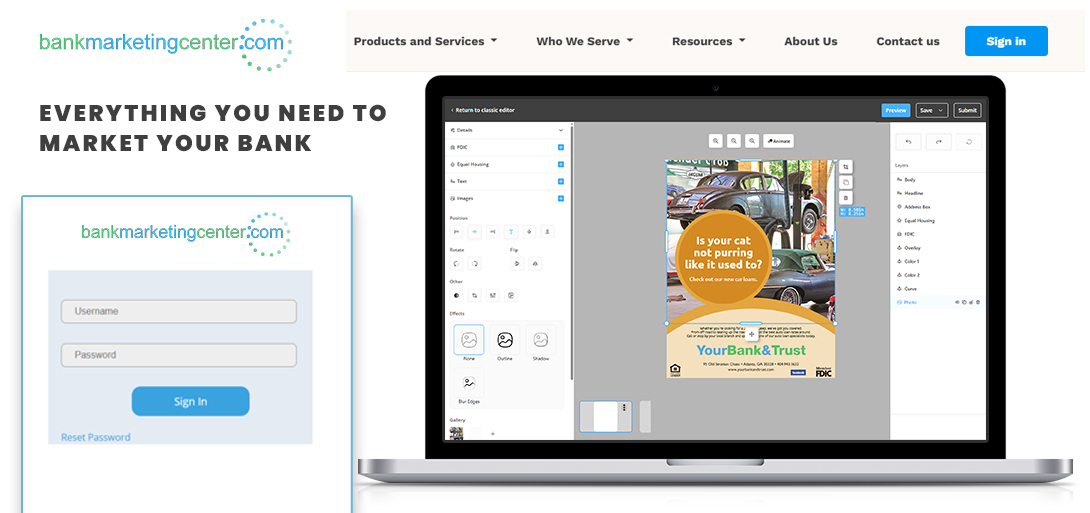
Bank Marketing Center came to us with a form-based HTML editor and 3,000 marketing templates that banks used to run their entire marketing operation. They needed a real drag-and-drop editor that understood vector graphics, CMYK output, and the actual print pipeline. Most candidates didn't even know what those words meant. We did, because we'd already shipped them.
Bank Marketing Center runs a web-based marketing portal that banks use to manage their entire marketing operation. Inside it, users browse thousands of templates, customize them, and ship the output to printers, vendors, publications, or social media. The original editor was form-based HTML. Users picked fields, swapped photos, and the system produced a PDF.
That worked until customers asked for more. They wanted to see the actual layout. Move elements around. Add their own. The team needed a real drag-and-drop editor that could handle 3,000 templates without rebuilding the foundation.
They had their own developers but didn't want to put them on this. They wanted someone who already understood the work, the editor architecture, the print pipeline, the vector graphics, the CMYK output. Most of the agencies they interviewed had never even heard of CMYK. We had already shipped it.
"Uforia Infotech's intimate knowledge of specialized matters is impressive. The team knows the ins and outs of all the technology behind PDFs, print graphics, and digital graphics."
The challenge wasn't building an editor in a vacuum. It was building one that integrated cleanly into BMC's existing platform and supported 3,000 live marketing templates from day one.
A real canvas editor on top of the existing portal. Users see the exact layout, move elements, add elements, swap images, edit text inline. Built on FabricJS with custom extensions for bank-specific marketing layouts.
Every existing marketing template had to work on day one. We worked alongside BMC's backend team on a custom API, then mapped every template into the new editor without breaking the form-based flow for users still using it.
Bank marketing materials go to commercial printers. That means CMYK color profiles and vector graphics, not RGB JPEGs. Our PDF pipeline preserves vectors end to end, converts color spaces correctly, and embeds fonts so output is print-ready.
Bank marketing isn't just print. Materials flow to vendors, printers, publications, and social media. We built an approval workflow that routes the finished asset to the right destination, with version tracking so compliance teams can audit what went where.
These aren't generic engineering challenges. They're the specific edges of Web2Print where a generalist agency burns three months learning and we shipped in weeks.
Most canvas tools rasterize on import. Drop an SVG logo into the editor and it becomes a JPEG with jagged edges at print resolution. Bank logos cannot pixelate on a billboard or a 300dpi flyer.
End-to-end vector pipeline. SVG and vector PDF assets stay as vectors through the editor, through preview, and into the final PDF. No rasterization until the printer's RIP decides to.
The web is RGB. Print is CMYK. A bank's brand red on a screen is not the same as the red that comes out of a commercial press. Get this wrong and you reprint a 50,000-unit run.
ICC profile-aware color conversion in the export pipeline. Brand spot colors mapped to defined CMYK values. Output PDFs flagged as PDF/X-compliant for commercial print.
The form-based editor was already in production with paying banks. We couldn't pause it, fork it, or rewrite the backend. The new editor had to slot in alongside it and consume the same data.
Built as a segmented module that integrates via a custom API designed jointly with BMC's backend team. Both editors share the same template data. Users could be migrated in waves, not in one risky cutover.
The end users are marketing managers at banks, not designers. They need full layout control but cannot break brand compliance. Letting them drag a logo off-canvas isn't acceptable.
Locked layout zones, snap-to-grid guides, brand-compliant color and font palettes per template, and constraint rules that prevent layouts from breaking compliance. Editable, but inside the lines.
Matt walks through what made the partnership work over nine years. From the first calls in 2017 to the v2 editor they're scoping with us now.
He explains why a Web2Print project lives or dies on whether the team already understands vector graphics, CMYK, and PDF rendering, and why the interviewing process for this kind of work is brutal if you're not specialized.
Not vanity metrics. The numbers that prove the partnership held up across multiple eras of the product.
Most agencies finish a project, hand over a repo, and move on. The codebase gets inherited, rewritten, abandoned.
Bank Marketing Center is the opposite. After the initial editor launched, we stayed on for maintenance, new features, and support. Nine years in, we're now scoping the second version of the editor with them.
That's what specialization compounds into. The team that built v1 already knows every edge case for v2.
If you're running a Web2Print operation that needs deep PDF, CMYK, and print pipeline expertise, you're exactly the kind of project we want to work on next. 30 minutes. No prep. No sales pitch.