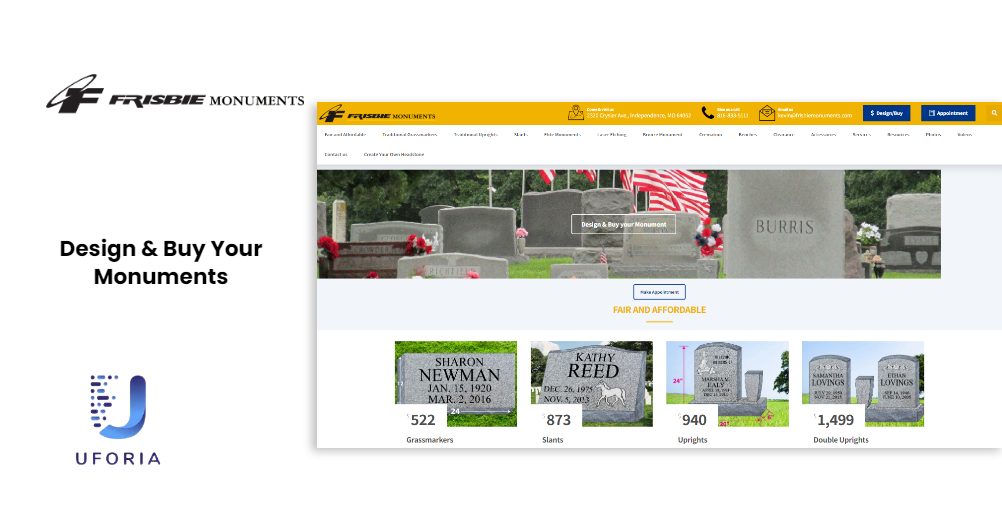
Frisbie Monuments came to us after another vendor stalled on a build they needed for their factory floor. We finished what the previous team couldn't, then built them a new B2B production tool for the wider monument manufacturing industry. Shipped in 2021. Live and in daily use in 2026.
Frisbie Monuments is a third-generation manufacturer based in Independence, Missouri. They make headstones, monuments, and plaques for families across the United States. Their website, frisbiemonuments.com, is the shopfront. But the real work happens on the factory floor.
By 2017, Frisbie had hired a different vendor to build them custom software for their production workflow. That vendor couldn't ship it. The build stalled. Frisbie reached out to Uforia after a smaller engagement where the communication and delivery had stood out. The brief was twofold: finish what the previous team couldn't, then build a new B2B production tool for the wider monument manufacturing industry.
The customer-facing side needed work too. The existing site lacked a real monument designer, wasn't mobile-friendly, and had no path to online ordering. So the engagement spanned both the production layer (B2B) and the storefront layer (B2C). Same team, both halves.
"Their communication is always good. Even if there are changes in the project, they were able to meet the timeline."
Most agencies pick a side: storefront or production. We built both halves of the Frisbie operation, because the same canvas data that lets a family customize a headstone online has to flow into the manufacturing system that actually cuts the granite.
Interactive canvas where families choose shape, material, size, and add custom engravings, photos, and decorative elements. Real-time previews so the customer sees exactly what they're ordering before they pay. Built on FabricJS with custom extensions for monument-specific constraints.
A monument is a one-shot purchase. Families can't return a custom-engraved headstone. So we added a 3D preview that lets them rotate the design, see depth, shadow, and proportion before committing. Reduces order errors and gives families confidence in a hard moment.
A new B2B product Frisbie wanted to sell to other monument manufacturers. Order intake, work-order generation, production tracking, and proof-of-design routing built around the realities of stone-cutting shops. The piece the previous vendor failed to deliver. We shipped it.
The old site wasn't responsive and had no ordering path. We rebuilt the storefront with a mobile-first layout, integrated e-commerce checkout, and connected the canvas designer to the order flow. A family on a phone can configure a monument and pay without bouncing.
Monument software looks simple from the outside. It's not. Custom geometry, manufacturing tolerances, photo engraving, and the emotional weight of a one-shot purchase all collide. Here's what we actually solved.
Frisbie's first vendor had left a half-built codebase with no documentation, broken builds, and architectural decisions that wouldn't scale to the production tool they actually needed. Most agencies would have insisted on a rewrite. That would have cost Frisbie months and lost their original investment.
We audited what was salvageable, kept the parts that worked, and rebuilt the parts that didn't. Shipped a working version in a tight timeline. Kevin's words to us afterwards: "Yes they were able to get the job done and other company could not."
A consumer design tool lets you put a 12-inch photo on a 6-inch monument. A manufacturing tool can't. The canvas had to enforce real-world constraints: minimum text sizes for stone engraving, photo aspect ratios that survive the etching process, and material-specific limits, all while staying friendly enough for a grieving family to use.
Constraint engine that runs alongside the canvas. Invalid configurations get blocked with plain-language explanations, not error codes. Material rules are configurable per product, so adding a new granite type doesn't need an engineer.
The factory needs vector files with exact dimensions, CMYK proofs, and engraving paths. The customer-facing canvas outputs pixels. Most teams build two separate systems and copy data between them. That always drifts.
Single source of truth: the canvas state. A server-side renderer converts that state into production-ready vector files, engraving paths, and proof PDFs. One change in the canvas updates everything downstream. No drift, no double-entry.
Frisbie didn't just want production software for themselves, they wanted to sell it to other monument shops. That means multi-tenant from day one: separate data, separate branding, separate workflows per shop, with one codebase to maintain.
Multi-tenant architecture with per-tenant configuration, isolated data stores, and a shared deployment pipeline. Each manufacturer gets their own production workflow without forking the codebase. Frisbie can onboard a new shop in a day instead of a quarter.
Engineering wins, not vanity metrics. Frisbie didn't publish revenue numbers. They published this software, and it's still running.
Most software written nine years ago has been replaced twice. The build engagement with Frisbie wrapped in January 2021, but the production tool we shipped is still in daily use on the manufacturing floor.
That's the part most agencies can't claim. We don't ship things that need rewriting in two years. We architect for the kind of business that's been around for three generations, because that's the kind of business Frisbie is.
If you're a manufacturer with a stalled software build, an ageing custom tool that won't die, or a B2B product idea that needs an engineering team that thinks past the launch: this is the playbook.
If you're a manufacturer or operator who needs engineering work the previous vendor couldn't deliver, that's exactly the kind of project we want next. 30 minutes. No prep. No sales pitch.
No obligation. No mailing lists. Fahad personally takes the call.